Blog

Eco resorts Bali, Making a Difference

Elephant Safari Park

The Elephant Safari Park and Lodge in Taro provides a peaceful sanctuary for displaced elephants, and a highly enjoyable experience for visitors to the island; but it is the story behind its creation, and the history of the gentle giants that ramble across it, that make this park so unique. It’s a chronicle of disappearing forests, neglected elephants, dramatic rescue operations, and a man with a mission and the will power to see it through. His name is Nigel Mason.

2

 “The elephants are our star attraction, so we treat them like stars,” says Nigel as an 800-kilo elephant called Desi playfully wraps her trunk around him. “Look, they are so gentle you can put your hand right in their mouth,” he demonstrates. I content myself with feeding our large friend bundles of young coconut leaves, for which I am rewarded with a great big elephant hug, I scratch the trunk that has a firm grip on my waist – its not exactly soft, but the all encompassing embrace is kind of nice.  30 elephants live in this lush oasis, with a landscape painstakingly created to replicate their natural habitat, the low lying rainforests of Sumatra.  As we wander around I find a flurry of elephant activity; some carry guests on forest treks, others kick soccer balls, or wade in the bathing pool soaking up trunks of water to give themselves – and anyone who happens to be nearby a shower.  A very cute baby elephant runs amok, trunk madly swinging, playing like a frisky puppy, he is one of three babies born in the park (a successful breeding program is a sure sign of animal wellness.) Although I had originally been reluctant about visiting the park – animal theme parks in Asia can be depressing places – I end up having a really inspiring and very happy day, surrounded by  these magnificent animals that are so obviously well loved and cared for. “We offer a complete elephant experience,” says Nigel, “we’re able to be really interactive, and guests can get close to the elephants in a way that they never could in a traditional safari park.”

Refugees

While you might be reading this and thinking,  “Surely these elephants would be better off in the wild,” the answer is yes, in an ideal world they would be, but these animals are refugees from the ongoing war of  man vs nature, that has seen the destruction of around 30 million acres of rain forest in Sumatra in the last 30 years.  “The species have been hounded out of Sumatra,” says Nigel. Rampant logging has destroyed much of their natural habitat; the rainforest that was once their home steadily replaced by oil palm and acacia plantations. Unfortunately an elephant isn’t discerning enough to differentiate between natural forest and man-made plantations – he just sees food.  A single hungry elephant wandering through an oil palm plantation can wreak havoc, eating up to 250 kg a day – that’s a lot of plants, and a lot of lost revenue. “Elephants are migratory,” says Nigel, “they follow fixed routes that may take 12 months to complete. The problem is, when they get back to where they started a year ago, the forest might be gone, replaced with an oil palm plantation for example – and believe me, oil palms are very tasty for an elephant, so suddenly people’s livelihoods are being destroyed.” Deemed as giant pests, farmers and plantation owners sometimes resort to poison, using pineapples laced with strychnine. The ‘lucky ones’ are rescued and relocated to Government training camps, forlorn places that lack the facilities and the funds to properly care for the elephants that literally waste away. Nothing evokes the magical allure of the jungle like an elephant, but for the 2000 or so endangered elephants living in increasingly fragmented pockets of Sumatra, and for the 700 incarcerated in the camps, the future is grim and uncertain.

 1

From Sumatra to Bali

It’s not like Nigel, as a child growing up in England and Egypt dreamt of one day coming to Bali to rescue elephants, but with a life that can only be described as adventurous and colourful,  it somehow makes perfect sense that this is what he ended up doing.  At the age of 15 he immigrated, alone, to Australia, making a living digging ditches and picking fruit, followed by a brief foray into the music industry. A spontaneous trip to Bali in 1980 sealed his fate, when he fell in love with the island, and not long afterwards with Yani, the beautiful Balinese woman who would became his wife. By 1989 they were running Bali’s first white water rafting tours, which soon morphed into the company Bali Adventure Tours. Nigel describes himself as an animal lover, but the elephants came into his life quite by accident when he met a man who had bought nine Sumatran elephants to Bali as a tourism venture, but was having trouble taking care of them. Nigel was so moved by the poor condition of the elephants who were living in a dried out rice field, that he knew he had to do something. “They deserved a whole lot more,” he says.  He secured some land in the hills of Taro, north of Ubud, and in 1996 opened the Elephant Park, originally as an adjunct to the rafting business. But Nigel is not a man who does things by half, once he took on the first batch of elephants, he set out to find out everything he could about the animals and how to best look after them. Within a year he was on his way to Sumatra to rescue eight more elephants from the government camps, returning with a ten -truck convoy that travelled six days non-stop to bring the animals to their new home in Bali. By 2000 the park had expanded and improved, to include landscaped gardens, a restaurant, a museum, water treatment, a sustainable waste disposal system and a breeding area. Ready to rescue more elephants, Nigel returned to Sumatra in 2001 planning to bring back another ten, but this mission turned into a four-year heart-wrenching bureaucratic nightmare, in the midst of which Bali was bombed, tourism plummeted and businesses across the island collapsed.  Finally in 2004 the paper work was in order, the funds secured and ten Sumatran elephants, including two babies were loaded onto trucks for the arduous trip across three islands to bring them to Bali. An Australian film crew documented the road trip and the resulting film ‘Operation Jumbo’  (available at the park) makes riveting viewing.


Some things you didn’t know about elephants

We walk on to the museum, where I get a crash course on the anatomy, myths and history of elephants. The collection includes original Dr Seuss and Jumbo prints, a 15,000 year-old giant wooly mammoth skeleton, and a pretty decent elephant painting by Ronny Woods.  I learn that in the past many elephants lost their lives so their tusks could be turned into billiard balls and piano keys. Moving on to the sprawling open-air restaurant, we take a seat overlooking the bathing pool and the picturesque gardens. Nigel tells me that the Sumatran elephant is the smallest in the world, up to five times smaller than its cantankerous African cousin. While they can be gentle and playful, they have strong and unique personalities and get bored and despondent if they are just hanging around.  They also need to exercise, so join the daily rotation for elephant rides, (the weight of two people is easily borne by an 800 kilo creature;) lodge rooms have their own docking station so guests get door to door service.  And yes, the adage about elephants having incredibly long memories is definitely true – Ramona, who came by truck in 1996 has gone on to become an exalted painter but she still dances, a trick taught to her by young boys during her days as a youngster in an elephant camp in Sumatra. As we chat, her baby, Guntun, the park’s cheekiest resident and expert gate opener streaks across the grounds, bellowing like a trooper, Nigel tells me that he has also developed his mothers aptitude for painting.


Elephant Art

While an elephant skillfully kicking a soccer ball or wielding a paint brush may seem a little gimmicky, I learn that in the wild they will often kick around coconuts, or use sticks, pebbles and leaves to make pictures in the earth. Nigel explains that the park elephants  are given the freedom to express themselves in whatever form appeals to them; those that have a natural aptitude for painting are actively encouraged, with results that can only be described as abstract.  Each has a different style – although Ramona’s mahout (handler) says “She paints only when she is inspired; ” some of her pictures have sold at Christies for over $3000. The elephants were taught to paint by the founders of the Asian Elephant Art & Conservation Project, who visited the Park in 1999. The aim was to produce saleable art to help raise awareness of the plight of these gentle giants, and to raise much needed funds for the park’s Sumatran Elephant Foundation. While Nigel hopes, in time to bring more rescued elephants to Bali, for now the Sumatran government has halted transmigration, so proceeds from the foundation are used to provide elephants in the camps with extra food, medicine, veterinary care and vitamins.

 3

Nigel breaks off from our interview to grab a chainsaw – it seems that one of the trees bordering the bathing pond is dead and in danger of toppling over, tourists gather round to enjoy the spectacle as he skillfully lands the offending trunk in the pond wades through to attach ropes and supervises as two elephants effortlessly haul it out.  His absolute commitment, accessibility and hands on approach to everything certainly accounts for a large part of the park’s success, as does his dedication to the environment.  For him, “Conservation is not just something that we should do, but something that we have to do.”  The park has been built to have a minimal impact and acts as a role model for safari parks around the world. “ We don’t just protect the environment, we remove anything that could damage it;” waste water is turned back into pure water through an advanced filtration/treatment system; manure (truck loads of it) gets turned into fertilizer, and 90% of the 150 staff are from Taro. The village also receives royalties from elephant treks and earns money through supplying food to the park.


How to help

Wild life and conservation groups applauded the declaration of the Tesso Nilo National Park in the Riau province of Sumatra in 2004, which has a forest block that is large enough to support a viable population of Sumatran tigers and elephants. “It’s a step in the right direction” says Nigel, but perhaps a case of too little too late, and a road has already been put through it, giving easy access to illegal loggers.  He encourages people to help the elephants by supporting the foundation through donations or buying art work, but for him the only way to really save the elephants, the orangutans, the tigers and all the other jungle creatures of Sumatra is to buy back large areas of forest to be used for national parks,  “But this, ” he says “would require large amounts of money from someone like Richard Branson or Bill Gates……..We live in hope.”


Making a Difference, Uncategorized

Saving the reefs of Northern Bali

The Indonesian archipelago is home to the richest assortment of coral species in the world, but its reefs are vanishing as global warming, pollution and unsustainable fishing and tourism practices take their toll.

Indonesia’s appalling conservation record is well documented and it would be easy to write yet another article about imminent disaster; but I am sick of all the doom and gloom, because with destruction comes regeneration.  While politicians  and environmental agencies gather in endless global summits and engage in pointless debates about how to fix things,  often the most effective change is happening at a grassroots level, and I knew that somewhere in Bali someone would be doing something to save the reefs.

I find my story in the north of the island, in a humble village that sits in the shadows of the mountains. Just meters off  Pemuteran’s  black sandy shore lies the  Karang Lestari (Everlasting Reef) Project, one of the largest and most ambitious coral restoration projects in the world. A reef that had badly damaged is once again thriving due to a unique technology called Bio-Rock, which uses electric currents to stimulate the growth of coral.

I have no idea what to expect, but this is unbelievable, a kind of futuristic underwater fantasy world. Fifty large steel structures span over 1000 feet and take the form of a caterpillar, a whale, an igloo, a dome, a tent, and a  flower,  all covered in a profusion of brightly coloured coral. Hundreds of tiny blue fish hover above the dome, bat fish flitter amidst the flowers. I see starfish, lionfish, a school of snapper and cheeky little Nemos everywhere. Soft pastel corals sway in the current and purple tipped table corals sprawl across the metal bars. The reef surrounding the structures is also thriving, everywhere I look I see life and vibrant colour. Natural power is the plan for future structures (which includes a Goddess rising from a lotus.) Reef Seen Aquatics Dive Center have already set  things in motion,  sponsoring two structures, a bio wreck and a giant turtle that are powered by solar panels.

Bio-Rock utilizes Mineral Accretion Technology which stimulates the growth of naturally occurring calcium carbonate, the substance that forms coral. Low levels of electric current (dc) are rigged to the structures which are then planted with coral fragments, minerals are attracted to the coral, the coral adheres to the structures and grows at an accelerated rate of up to five times. It also produces a veritable super coral that is hardier and more resistant to changing water temperatures and pollution. Healthy coral brings fish, and when combined with a ‘no fishing’ policy, it acts as a breeding ground thus replenishing fish stock for outer reefs.

Back on land, I spend time with Komang the Manager of the Bio-Rock centre, he has been involved with the project since its beginning and his dedication and insight is inspiring. He tells me that, “Bio-Rock is good because it brings the tourists, which bring money to the community, and it also brings fish so it keeps the fishermen happy.” Herein lies the true significance of the project because along with reef restoration came social and economic rejuvenation.

Traditionally Pemuteran was one of Bali’s most impoverished fishing villages. During the nineties tourists started to trickle into the area drawn to the stunning reefs. But in 1998 double catastrophe struck; El Nino sent warm currents across the globe causing mass coral bleaching; and the Asian economic crisis sent waves of starving itinerant Indonesian fishermen into Pemuteran, where the bounty was plentiful. They were armed with  dynamite and cyanide (used to stun fish to gather for aquariums) and the peace was shattered by exploding bombs.

All too often conservation conflicts with traditional resource users. How do you tell a starving fisherman that he cannot take the fish? Komang says that he couldn’t blame the fisherman because “They were only looking for this time, not the future.”  They didn’t know any better. The key to sustainability is education, and the availability of viable alternatives, and behind the scenes a group of colourful characters had been providing this.  Chris Brown the owner of Reef Seen Aquatics and a long term and well loved resident had worked tirelessly with the community  and village leaders to instill the need for sustainability and was joined by Pak Agung, the Balinese owner of  Taman Sari resort; and Rani and Narayan, ardent divers who were former members of a large religious community.  Chris tells me that “You have to take things slowly, so that they get done quickly and slowly but surely the fishermen understood. In a unique turn of events Adat (traditional) law was applied to create a no fishing zone and the Pecalang laut (marine security forces) were formed to chase of the cyanide fishermen.

Encouraged by community  efforts to conserve the reef, more colourful characters entered the scene; Dr Tom Goreau, an impassioned Jamaican marine biologist and Professor Wolf Hilbertz the German scientist who had discovered Bio-Rock. Together they had formed the Global Coral Reef Alliance and  donated their time and energy to Pemuteran, the first structures were placed in the sea in 2000. Karang Lestari has received numerous environmental awards and Government recognition, however it has been entirely sponsored by private donors and operates on the tightest of shoe string budgets. Recent initiatives include the opportunity to ‘Sponsor a baby coral’ and the establishment of PET (Pemuteran Environment and Community Trust) whereby divers can make a voluntary donation of RP 20,000 or more.

Similar projects have been attempted in other locations but without the support of the community are doomed to failure. A key to the success of Karang Lestari has been the implementation of other projects that enable the community.  Chris initiated the recruitment of ‘Reef Gardeners’ who are trained to maintain and protect the reefs, and a Turtle Hatchery which  protects sea turtles and their eggs. The Pemuteran Foundation, PET, and private tour operators also support these and various other programs aimed at education, tree planting and clean water.

To say the village is prospering would be an overstatement, but life for its inhabitants has improved dramatically. As  Komang tells me,  “Now no one is hungry.” Fishermen have been converted from hunters to protectors and have seen that conservation means more fish. Villagers have learned that by protecting the sea they benefit financially because the restored reefs bring tourists which create jobs and business opportunities, which in turn gives access to education and health care. Everybody wins!  It might just be one reef and one community, but it’s a step in the right direction and  Pemuteran acts as a model for fishing and diving communities everywhere.

For more information or to make a donation check the following websites, or take a trip to Pemuteran and see for yourself….

www.balitamansari.com

www.pemuteranfoundation.com

www.biorockbali.webs.com

www.reefseenbali.com

www.globalcoral.org

Making a Difference

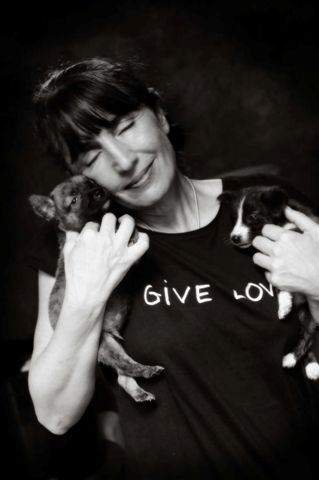
Bali Animal Welfare Association

BAWA (Bali Animal Welfare Association) was founded by Janice Girardi, a Californian native who rescued her first Bali dog in Kintamani 27 years ago, so beginning a one woman crusade to improve life for man’s best friend across the island. Her passion for animals and their welfare is consuming, and she is an inspiring example of how one person really can make a difference. For years she has been feeding street dogs and rescuing sick and injured animals, loading them on to a makeshift stretcher and driving them to the vet in Denpasar. In 2007 she formalized her position and along with one of Indonesia’s top veterinarians, Dr Dewa Dharma, created BAWA. Finding homes for puppies is just one of BAWA’s programs: The not-for-profit charity also supports a 24 hour clinic; an animal ambulance; a mobile sterilization clinic; an education program; and a range of community projects.

The care centre in Gianyar is run by a dedicated team of volunteers and staff and houses an average of 50 dogs and cats at a time. The level of care is heartening and eventually BAWA will find homes for all these animals, even if it means paying impoverished farmers with monthly rations of rice to take them on.

Dogs have not always fared well in Bali and the notion of having a dog as a pet is a new concept, but one that is slowly catching on. Janice describes education as, “The only hope for lasting change,” and her staff are active in schools and in the local communities. “The Balinese are learning that if you love a dog, it will return ten-fold,” she tells me.

BAWA survives soley on donations and the recent outbreak of rabies in Bali is consuming enormous amounts of resources as Janice and her team embark on an island wide mission to vaccinate dogs. For more informaion or to make a donation check http://www.balibawa.com

Making a Difference

From Trash to Treasure

Bombastic Plastix recycles plastic bags and turns them into funky accessories.


They are handed out gleefully by cashiers the length and breadth of the island, used once and abandoned. Their fate − to float down rivers, ride the waves, wash up on the beaches or smolder in black smoky fires.…. In Bali there is no escaping  plastic bags.   But there is always hope, and a small company called Bombastic Plastix  is hard at work turning plastic trash into  funky fashion accessories.

Recycled products often get a bad wrap (no pun intended) because they are produced poorly with little thought for design. But Bombastic Plastix has turned recycling into an art form and their products – bags, purses, wallets,  are attractive in their own right, regardless of their ‘greenness’. Let’s face it, most of us want to do our bit to save the planet but there is nothing wrong with looking good while we are doing it.

It all started a few years ago, on Bombastic founder, Sam Miller’s kitchen floor. He was a man on a mission, armed with an environmental conscience, a keen sense of design, a heap of plastic bags and an iron. Through trial and error he discovered a way to fuse plastic bags into sheets of plastic fabric, which form the base of all his products.  “Its hardly like we are using all the plastic in the world,” he tells me, “but at least we are using some of it; and we are taking something that has a service life of 30 minutes  and converting in into something that lasts years.”

Check out the website, its great fun and really informative, and you will love Sam – he is one super cool dude!

http://www.bombasticsplastix.com

Eco resorts Bali

Sarinbuana Eco Lodge

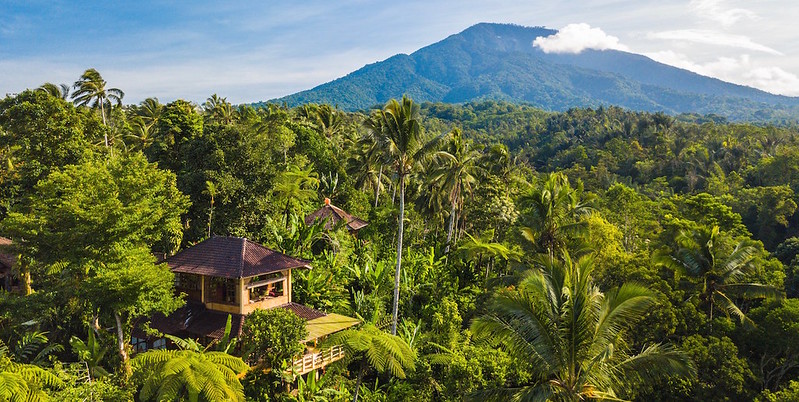
33735398488_83dc15d27a_cWith a picturesque setting on the slopes of Mt Batukaru, Sarinbuana Eco Lodge provides a genuine haven for those looking to immerse themselves  in nature and to experience the true essence of  Bali. Charming, secluded bungalows with names like Tree House and Jungle Lodge cling to the hillside, wooden verandas offer birds eye views of  steep valley walls blanketed in thick rain forest; far below you can see the sprawling coast of Kuta – so near,  yet  a world away.
The first thing you will notice is the bird song– woodpeckers, kingfishers and  parrots are at play in the forest canopy, black eagles streak across the sky , the looming peak of  Mount Batukaru creates a dramatic backdrop. Natural building materials include local timber, like coconut and jack fruit,  while floors are made of hand crafted terracotta tiles. Fresh cut flowers, colourful woven textiles, and warm patchwork quilts (the nights are chilly!) create homely comforts.

47483136531_9dfd0a84b8_c

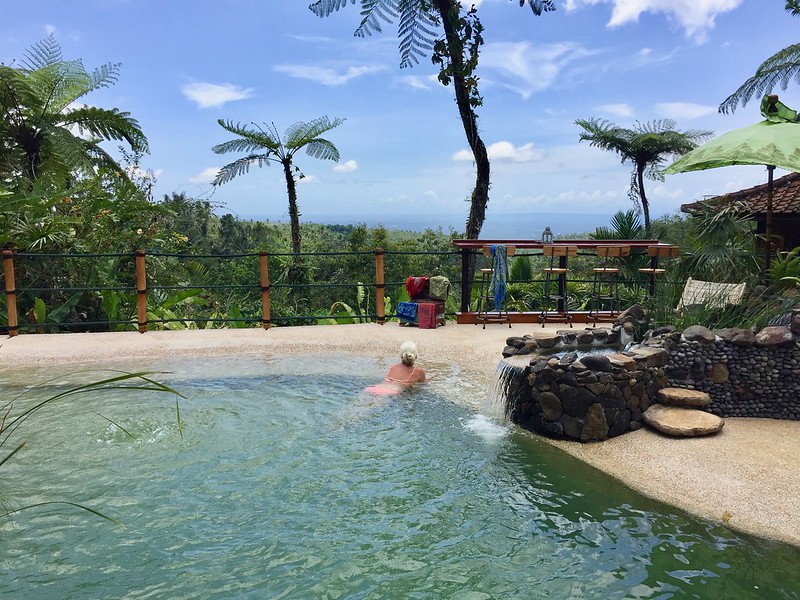
The natural swimming pool is the newest addition to the lodge, and a welcome one, with panoramic views over the rainforest right down to the coast. The lodge also offers yoga classes in a dedicated yoga pavilion, with more of those incredible bird’s eye views.

49504119961_1f62e3d798_c

49376628222_dbac7674c5_c

Being Green

The lovechild of dedicated environmentalists, Linda and Norm Vant Hoff, the lodge is about as  ‘eco’ as it gets, with well documented  green credentials, including the ‘Responsible Tourism Award’ in 2007 and 2010 (www.wildasia.net) The tenets of sustainability, low impact building techniques , effective resource and waste management, are all faithfully adhered to, everything is in perfect balance with nature; but we sometimes forget that there is more to the environment than  physical factors.

From Norm and Linda’s point of view,  an eco lodge is “Sustainably connected to the natural, built and social environment”; and the lodge has become a valued  extension of the village and community of Sarinbuana. While you enjoy the magical surrounds, delicious healthy cuisine and a range of activities, you can also relax in the knowledge that   your stay  here contributes to the local economy on a number of levels: The lodge employs 26  staff from the village and have trained locals as trekking guides and massage therapists. Ongoing community projects include extensive tree planting, free English, martial art and football classes for village children, and ongoing additions and  improvements to the school. It also  acts as a role model for responsible tourism; promoting low impact activities, with an emphasis on walking, bike riding, and swimming.

Enormous value is placed on the preservation and promotion of  local culture, with popular workshops providing genuine insight into everyday life in Bali and the chance to learn traditional skills.   Learn Balinese Calligraphy, Indonesian language, and how to play a traditional instrument, or join the  village ladies who teach the art of  creating beautiful temple offerings, table settings, and cooking;  while Pak Ketut, a remarkable and inspired wood carver (responsible for  the ornate carvings in the bungalows) shares his craft and his wisdom.


A walk in the garden

When Norm and Linda first took over the property it was dominated by wild grass and coconut trees,  eighteen years on the gardens are flourishing with over 150 edible and medicinal plants.Much of the produce served in delicious meals in the restaurant (including a great selection of vegetarian and vegan)  is picked fresh from the garden, or sourced locally, including coffee and cacao, and home made ice cream is flavoured with the vanilla that grows here. Make sure to join the complimentary garden tour to see fiddletip ferns, dainty  ginger flowers, sweetly perfumed orange trees, dense thickets of mulberry  bushes and  dangling passion fruit vines. Wooden benches and open air pavilions are scattered about the property, ideal for  meditation and soaking up the silence. If you are feeling more energetic take an early morning hike up to the top of Batukaru, the track leads through the largest rainforest in Bali, home to luwak (civet) leopard cats and monkeys, emerging at a peak with  view stretching over to Lombok and Java .

Version 2

The beauty of the  Eco Lodge is  that it can be enjoyed on so many levels , hide away from the world in a secluded mountain paradise, or put yourself out there as you immerse yourself in the nature, culture and  community.  Make sure you spend some time with Linda and Norm so you can learn about their various eco projects around the island, including saving the Bali Starling, permaculture, solar energy.  For Linda the Eco lodge has provided “A chance to give back” but she makes it clear that she gets back as much as she gives.  For her the greatest joy is, “To be connected to the environment, the people and the  land,  making a living and a life with local people who are incredibly talented.”  Here the Balinese concept of life, known as Tri Hata Karana is firmly in place – the three forces of happiness – harmony with god, harmony with man, harmony with nature.


Sarinbuana Eco Lodge, Mount Batukaru, Tabanan, Bali

www.baliecolodge.com

Uncategorized

Balinese Boreh

The colossal gateway of carved stone fringed by vast banyan trees, sets the tone for Nusa Dua Beach Hotel and Spa, an atmospheric  resort deeply imbued with Balinese warmth and charm. The famed spa is set just outside the gates in a peaceful oasis of wonderful old trees, and makes a great day trip. Treatment pavilions encircle a lavish swimming pool bordered by frangipani and heliconia, and there is full access to tennis and squash courts,  gym, sauna and steam room. The cafe serves up healthy salads and sandwiches, as well as fruit mocktails like Coconut Nojito with mint and coconut cream, pressed lime and Bali honey. Beauty classes teach the craft of  creating traditional body masks such as Balinese Boreh, and scrubs like Javanese Lulur, as well as local sunburn remedies, and jamu (traditional herbal remedies.)

We tried

The spicy detox treatment based on ‘boreh’, a traditional rejuvenating treatment popular in the mountains of Bali, where nights can be chilly. The deep penetrating heat of local spices is also favoured by fishermen and farmers, as it increases blood circulation and relieves aching joints.

Our treatment takes place in a lush spa villa for two and starts with an invigorating sea salt and peppermint foot scrub. A nurturing massage with warm herbal compresses of fresh betel leaf, citrus oil, and fresh lemon grass lulls us into a deep state of relaxation. Next, a mask of fresh crushed ginger, nutmeg and clove is applied and we are wrapped, cocoon-like, leaving the  spices to warm our bodies and detoxify our skin. The treatment finishes with a cooling application of fresh cucumber to seal in moisture.

The Verdict

The delicious warmth of the spices heats the muscles and the joints, melting away tension leaving us in an atrophic state. The wrap also acts as an exfoliator, removing dead cells to reveal silky, luminous skin.

Also Recommended

Signature packages include scrubs, massages and baths. Try Latte Detox with milk and honey;  Fruit Punch with Papaya and Avocado; Royal Exotic with Lulur body scrub and yoghurt mask

www.nusaduahotel.com

Yoga and Meditation

Bali Spirit Festival

“There is no sense of us and them, just a sense of unity”

Jamming

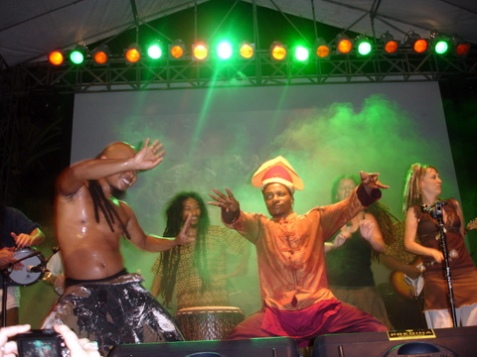
Billed as a celebration of yoga, music and dance, the second annual Bali Spirit Festival brought together 20 yogis and teachers, 75 performers and over 1000 festival goers. The  enchanted gardens of the Purnati Centre for the Arts twinkled with fairy lights, setting an atmospheric scene for the opening ceremony.   There was a palpable air of anticipation and excitement as we stretched out on the sloping grass for the evening’s entertainment which included a traditional Balinese blessing,  African reggae music, American folk music and a fire dance fire show, just a small taste of things to come over the next five days.

Akim funk buddah

The festival is truly multi faceted, bringing the spirit of yoga and world music to Indonesia and at the same time showcasing the culture, the music and the spirituality of Bali with a global audience.  The zero waste policy was part of the founders desire to create an environmentally conscious event and there were bamboo cups, banana leaf plates, water bottle refilling stations and recycling bins for non organic matter. Amidst the market stalls were information booths on various non profit organizations such as SOS (Sumatran Orangutan Society), Breath of Hope Yoga Foundation, The Pelangi School and Feed Our Earth Society.

dance workshop

Daytimes were about learning, and workshops took place in the elaborate pavilion or the elegant white marquees that sprawled across the expansive lawns. Palm trees created shade; the hum of the rainforest and the sound of the flowing river provided the soundtrack; while verdant tumbling rice paddies created a scenic backdrop. The  eclectic mix of workshops on offer included; West African Dance, Mayan Cosmology, Yoga and Pilates,  Holistic Hip Hop, Javanese Movement Meditation, Qi Gong, Didgeridoo Workshops, and Sacred Middle Eastern Music Traditions. At times I felt a little overwhelmed, there was just so much going on. Did I want to purify my chakras? or join the Sacred Balinese Feminine Dance class? or attend a seminar on Ayurveda? Or did I just want to lounge in the infinity pool which perched tantalisingly over the river?

infinity pool

My concerns that it would be full of really earnest hippy types dressed in white and talking about peace and love proved to be unfounded. Certainly there was a small element of that, but in fact the participants were as diverse a mix as the presenters themselves. There were professional women from the US and Australia, European backpackers, Ex pats, Japanese and Koreans and a number of Indonesians ─ predominantly yoga students from Java. I was a little baffled by all the ideological stuff: There was talk of cross-boundaries and cross cultural values of awareness; of musical collaborations positively impacting consciousness; Of sharing with the collective…… But what I do know is that I met really interesting people, learned lots of new things, felt incredibly inspired and empowered,  had a thoroughly good time and left feeling absolutely fantastic!

yoga

Far from being a serious affair, what really stands out in my mind is the sound of laughter rippling across the grounds, and I am not just talking about Laughter Yoga, although it did have a huge turn out and the peals of laughter emanating from the workshop were so loud and so contagious that everyone in the vicinity was laughing. Sibo Bangoura had us all  giggling during his African Drumming workshops as he yelled out “Get the police”, every time someone missed a beat.  Rebecca Pflaum made us stretch our arms up in the air for four minutes in Kundalini Yoga, calling out, “When it hurts and you can’t handle it a second longer, laugh and get over it”.  We then had to lie on our stomachs and make fists with our hands for what she called the butt beating asana, “This is for every time you have wanted to kick yourself in the ass”, she shouts out.  In the Ecstatic Dance workshop, Ellen Watson had everyone dancing around being fairies “Spread your fairy dust”, she told us. I felt kind of silly, in fact it took me five days to pluck up the courage to participate in a dance workshop, but the way I figured it, if a 60 year-old guy with a moustache and a beer gut can dance like a fairy, well so could I.  It was incredibly liberating to play like a child, to let go of inhibitions and of course by the end we were all falling about laughing.

ecsstatic dance workshop

In the spirit of collaboration there was very little separation between the participants and the presenters. Sibo Bangoura came to Kundalini Yoga, Rocky Dawuni, the African Reggae star brought his young daughter to the Crystal Healing workshop, Movement teacher Sofia Thom joined the Celebration of Women Yoga class. And Rebecca the Kundalini teacher was usually the last one on the dance floor at the nightly concerts. And as we the participants pounded out African rhythms, or grooved to hip hop or learned the Kecak monkey chant, we became the performers. Program Director Daphne Tse said that the best part of the festival for her was the “Melding of all disciplines, seeing everyone from first time yogis to master teachers so eager to learn from the others, to practice different disciplines. There is absolutely no ego. They are Bali Spirit”.

healing circle

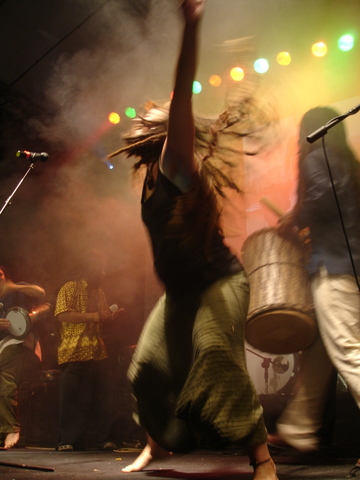
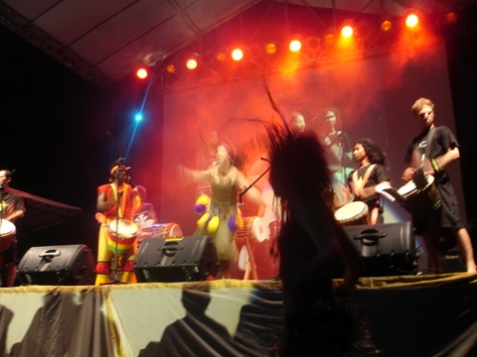
Nightly concerts took place in the amphitheatre, complete with stunning lighting and excellent acoustics.  Cocktails and beer were served and we were treated to some really incredible performances. Saharadja, featuring Javanese Jazz trumpeter Rio Sadik and his Australian wife Sally Jo, a classically trained violinist, played their electrifying jazz fusion. Rocky Dawuni got the crowd swaying to his mix of reggae and African beats. Sibo Bangoura and Australian based In Rhythm had everyone bouncing to the booming percussion; Sibo played his drum so hard the skin broke.  Hip Hop artist, Akim Funk Buddha  mesmerised us with his moves,  while Australian ensemble, Ganga Giri, provided an unforgettable musical experience with a spine-tingling blend of traditional didgeridoo with tribal beats and dub.

Saharadja

I met Megan Pappenheim (who founded the festival, along with her husband, Kadek Gunarta, and Musical Director, Robert Weber) for lunch one day. We sat on the grass and ate organic nasi campur from banana leaf plates. A drumming workshop took place behind us and the heavy beat of the djembe punctuated our conversation. She is incredibly vital and personable, a kind of one woman holistic dynamo and her passion for Bali and her local community is all too evident. This is a woman who really cares. Megan set up the website Balispirit.com in the wake of the 2002 bombing, its mission was to revive the islands stricken industries and to preserve its environment, culture and spirituality. The site, a kind of one-stop shop for all things holistic has proved to be enormously popular and now boasts over 150,000 direct hits a month. Since its inception at least 10 new yoga centres have opened up and around 40 retreat groups are converging each year. Her other ventures include a food café, a yoga shop and the Yoga Barn. She operates all her businesses under fair trade principles and employs over 70 local people, although the number doubles during the lead up to the festival. She tells me, “We are not here patting ourselves on the back saying we have done so much for the community but it’s a start, it gives an example, we want to inspire other people to do something similar.”

We talked about the huge amount of support and encouragement that the festival has gained, including that of the Bali Tourism Board as well as the Ministry of Culture and Tourism. When one of the major sponsors dropped out at the last moment there were fears that the event would be cancelled, but most of the performers offered to waive or greatly reduce their fees. In fact the festival has run at a huge financial loss, but as she says “Its not about the money, its about the message,” and she is already enthusiastically planning next years event in which she is thinking of choosing an AIDS charity  as the beneficiary and hoping to get a condom company as a sponsor. She also wants to have more non-profit organisations in attendance, “Creating an information warehouse”.

yoga in the lawn pavillion

We discuss the Bhinneka Initiative, the charitable arm of the festival. Bhin.n.eka tun.ggal ika translates as Unity in Diversity and its goal is to work with Indonesian youth to inspire new understandings of social awareness and global responsibility.  The musical outreach program featured Pre-festival concerts headlining Michael Franti, Rocky Dawuni and Tom Freund and raised over $20,000 for the Pelangi community school. As part of the Yoga Outreach program, Indonesian Muslim yogini, Pujiastuti Sindhu conducted free yoga workshops for the women of the surrounding villages of Ubud. International celebrity yogini Katy Appleton also conducted free pre natal classes at the Yayasan Bumi Sehat natural birthing clinic in Nyuh Kuning. I traveled with Katy to the clinic, a humble establishment, run by a non-profit organisation which sees about 50 births a week. It’s a long way from London and her celebrity clients which include Sarah, Duchess of York and Paul McCartney. Eight heavily pregnant local women attended and she led them gently through a series of positions. Afterward Katy was beaming and said doing the class had been “a sweet honour and great fun and that she was looking forward to returning for a longer time next year to help out with another pair of hands and a smiling heart”.

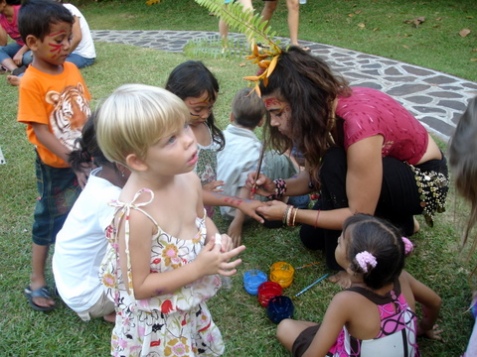
Also under the Bhinneka Umbrella came Hari Cinta Keluarga (family day), the final day of the festival which was free for all and and offered a range of family and children-oriented workshops. There was a good turnout of Balinese, who joined in the pre-natal classes and the children’s yoga workshops. Kids played drums with In Rhythm and Sibo Bangoura, danced to the sounds of Kirtan; and learned music with Lebanese artist Khalife, who will also be conducting a series of free workshops with street kids in Jakarta. Tom Fruend from California performed songs from his album ‘Hug the trees’ and had all the children dancing enthusiastically at the front of the stage.

face painting

The musical highlight of the festival came on the last night when the festival closed with the Siki Seka Jam which saw 15 of the festival’s performers up on stage all doing their own thing but somehow bringing it all together in a truly rousing finale that had everyone up and dancing. Seeing performers from so many nations and so many genres on the stage and playing as one captured the spirit of the festival perfectly. I thought about what Festival Director Amsalam Doraisingham said in his opening address, “You are here. This is your space and time. Let your light shine.” And when a thousand people let their light shine they create something that goes far beyond the individual. It was a journey for all of us, we  learned and shared and created and we all took something home with us, a little bit of Bali Spirit I guess.

Jammming

Uncategorized

Bali Eco village

We abuse land because we regard it as a commodity belonging to us. When we see land as a community to which we belong we may begin to use it with love and respect.

Aldo Leopold    

High in the hills, in a valley shrouded in morning mists and perpetual tranquility, Bali Ecovillage provides a welcome sanctuary  from the excesses of southern Bali.

Bali Ecovillage  is set in a mountainous valley to the west of Kitamani, surrounded by bamboo trees, rainforests and coffee plantations. Original plans were for a weekend house built in bamboo, a place for the owners to relax and revel in the beauty of nature, but as the walls grew, so too did the idea of turning this peaceful sanctuary into an eco lodge that others could also enjoy;  guest bungalows and a couple of spacious villas were soon added to the plans.

Bamboo is increasingly popular as the eco building material of choice; a fast growing woody grass, it absorbs four times as much  carbon dioxide as slow to harvest timber, is lighter than steel, and five times stronger than concrete. Plants can grow several feet in a day and a field of bamboo can be harvested and used for construction purposes within three years of planting. If well treated and maintained it is also super resistant. The simple elegance and quiet strength of the  bamboo plant is mimicked in the rustic buildings at Bali Ecovillage , thousands of poles in shades of light and dark have been tightly bound together creating rich textures and dimensions. The building design was largely experimental and the results are quirky and enchanting with a hotchpotch of influences from around the archipelago, with a good measure of Italian flair thrown into the mix. The lodge is fitted with comfortable sofas, great books, a pool table, and a dart board, while evocative artifacts from Papua New Guinea  are scattered throughout the lounge and bungalows.  Sunlight peeps through the skylights and an expansive deck offers panoramic views of the surrounding mountains,  this is the perfect place to soak up the silence, and breathe in air that is so fresh that the blast of oxygen makes you giddy. The atmosphere is cozy and homely, with evenings spent warming toes by an open fire,  perhaps curled up with a book or a board game, and a mug of steaming hot chocolate.

The word ‘eco’ is often just a catch phrase, but at Bali Ecovillage it is given full credence, the aim is to become a fully sustainable tourism facility, and to ‘give back’ to the local community, providing employment, training and education as well as acting as a model for eco tourism in the region. Waste is segregated with recycling handled by Eco Bali, and  organic matter composted or fed to the animals. Water is locally sourced, and garden water recycled, while the river has been harnessed to create hydro electricity that supplies some of the property’s  power needs. Activities are wholesome and ‘back to nature,’ visitors can learn how to make Balinese offerings; enjoy traditional massage;  bathe in the river or hike through the jungle. Rafting, cycling and rice paddy tours can also be organized. Guests are encouraged to explore the organic farm, with its extensive vegetable gardens, free range chickens, ducks and pigs. The homegrown cuisine adds to the wholesome atmosphere, and is even more enjoyable with an appetite stimulated by the fresh mountain air. Pick your own salad from the thriving greenhouse and enjoy homemade pasta, breads, jams and cakes.

Bali Ecovillage gives a glimpse into another side of Bali and is truly a place to recharge body, mind and soul.

www.baliecovillage.com

Eco resorts Bali, Yoga and Meditation

The Magic of Desa Seni


At  Desa Seni  the path to well being is scattered with flowers…..

As my friend and resident Kundalini yoga teacher Daphna says, “It’s a place of peace and joy, from the moment you enter any stress evaporates…. it’s a happy place.”

Desa Seni has been keeping me sane for the past two years, a sanctuary that is most certainly my happy place, where I can escape from work and every day pressures, and  lose myself in the beauty of my surroundings and in the ancient practice of yoga. At early morning classes  I  watch the flowers unfurl as I stretch into sun salutations, while sunset classes are filled with the golden glow of dusk and the flickering light of candles against a crimson streaked sky.

I always feel like I am stepping into a fairy tale as I follow the stepping stones that lead through colourful vegetable patches and heavily laden fruit trees. Everywhere I look there is something of beauty that has been thoughtfully placed to create joy ; a quaint wooden bridge, an  ancient dug out canoe filled with flowers, a wooden statue decorated with frangipani, or a carefully labelled tree or plant.

I once spent a weekend at Desa Seni staying in one of the charming antique wooden houses gathered from across the Indonesian archipelago. My beautiful house came with a  written story that detailed its origins, and that of all the antiques that filled it. In the afternoon one of the staff dropped by with fresh fruit and herbal tea and when I woke in the morning there was a traditional Balinese offering placed on my verandah with a card explaining how to make the offering to my own small temple.

Tom, the ever-inspiring man behind Desa Seni describes how he saw the island “blooming and growing” but felt that no one was staying true to Bali. His vision incorporated farming, yoga, unlimited potential for creativity, and integration with the local community. His founding belief , “If we all give back, educate, inspire and nurture, the world will be a better place.” I love that Tom is a man of his word and Desa Seni gives back to the community on so many levels, from being organic and green, to free English and yoga classes for the staff, to organising beach clean ups and to sponsoring worthy organisations such as Sacred Childhood Organisation http://www.sacredchildhoods.org/ and initiatives such as Ayu Kita Bicara which raises awareness about AIDS in the community.  Through Kula magazine Desa Seni continues to spread the word and promote like minded people and businesses on the island.

Desa Seni reminds me to always take a little time for myself to reconnect with the magic and beauty of life – something that I sometimes forget. Here I see positive vibrations leading to action, and remember that we can make a difference. Love certainly isn’t all you need – but it’s a great place to start!

www.desaseni.com

Healing

The healing power of crystals

Image

The human connection to crystals and stones spans time, cultures, continents and religions. Ancient Sumerians included crystals in their magic formulas; Egyptian pharaohs had their headdresses lined with malachite in the belief that it helped to rule wisely; while native American shamans used them for divination and healing. Their curative properties are mentioned repeatedly in ancient Vedic Hindu texts and referred to in the Old Testament of the Bible; while the mysterious black stone at Mecca (possibly a meteorite) forms an intrinsic part of the Islamic pilgrimage.

Image

In 1880 Jacques and Pierre Curie discovered the piezoelectric property of quartz  – when squeezed or stretched, a voltage is produced across the crystal’s face. These days crystals are utilized in almost every form of technology. Liquid Crystal brings us the clarity in our computer screens, quartz keeps watches ticking, and electronic grade crystals are used in cell phones, clocks, games, television receivers, radios, computers and navigational instruments. But although science readily accepts the vibrational qualities of crystals, when it comes to the less tangible realms of crystal   therapy,   the suggested positive vibrations of gemstones is often relegated to the fringe of ‘new age;’  even though it is a tradition that is about as ‘old age’ as you can get.  We have been communing with stones in one way or another for as long as we have roamed the earth.

Like many before me, I have a fondness for adorning myself with gemstones and jewels and this story starts with my discovery of Atlantis, a shop in Seminyak filled with glittering gemstones, gleaming jewel encrusted silver bracelets, shimmering druzy pendants and crystals in all shapes and forms.  I left wearing a striking pendant of amethyst wrapped in a silver serpent.   I loved the way it felt on my skin, the way it shimmered in the sunlight and I started to wonder why we are so drawn to stones and crystals. Is it because we are naturally attracted to that which is beautiful? Is it a primal connection with something that is formed deep within the earth’s crust, or is it something more; could it be possible that stones hold some sort of therapeutic power? So I decided to try and find some answers. I had no expectations, just an open mind, a touch of skepticism and an abundance of natural curiosity.

The story became quite a journey that led to interesting people, places and experiences, I learned a lot about crystals, physics and geology, and I learned a lot about myself and my own belief system. My encounters with crystal therapy in various guises were thought provoking, sometimes profound, and always left with me a smile.  I can’t claim to have found all the answers I went looking for, or to have been miraculously ‘healed’ (thankfully I have no major ailments,) but I can share my experiences and the findings of those far more knowledgeable than myself.

Vibrations……..

The more I delve into the crystal realms, the more I come across this term. Is this the key – can the vibrations of crystals affect our bodies or our minds in some way? Quantum physics recognizes that everything vibrates, even the tiniest atom, but certain things, due to their composition will vibrate at a higher frequency.  For example, quartz which is 100% crystal, resonates clearly and harmoniously due to a highly organized molecular structure.   We have all experienced ‘good vibes’ and the  sense of harmony  experienced by  listening to music, visiting certain places or meeting someone that we feel in tune with; as  opposed to situations or people that create discord  and throw us off balance. Similarly when we are attacked by viruses or subjected to stress we feel out of sync. A holistic approach to therapy is all about restoring balance, so maybe the vibrations of certain crystals can help. This makes sense, but the link is still tenuous. Then I stumble across a book called “Hidden messages in water,” by Doctor Masar Emoto.  The book contains a series of astonishing photographs, in which single drops of water were frozen and the crystals they formed captured.  Fresh spring water produced beautifully formed crystals, whereas city water barely produced crystals at all. But here’s where it gets really interesting, when Bach was played to water, the resulting crystals were magnificent, but when heavy metal music was played to the same water, it produced badly formed crystals or none at all. Town water that had initially created ill formed crystals – suddenly made perfect formations after 500 people simultaneously prayed for it to be clean. The most beautiful of all crystals had been exposed to the words love and gratitude. In all these cases the structure of the water was fundamentally  altered due to the vibrations it was subjected to. As Humans bodies are comprised of over 70% water, is it possible that our physical process can be altered by positive vibrations?

Image

Vogel and crystals

According to Marcel Vogel who spent much of his life conducting extensive research into quartz crystals, it means precisely this! Vogel was a highly respected research scientist who received over 100 patents during his 27 years working for IBM.  He discovered that he could fundamentally alter the structure of water by spinning it around a tuned crystal.  Using such a process, the ph levels of water could be sufficiently altered, the freezing point significantly lowered and the molecular patterns rearranged and restructured.

In the same way that the healthy water in Emoto’s experiments created beautiful well formed crystals; the water found in healthy tissue cells in our bodies is formed into organized, geometrically shaped molecule patterns. While unhealthy and cancerous cells feature ungeometric and disorganized water molecules. Vogel’s findings showed that the clear vibration resonating from crystals helps to organize the water in our tissues and cells, creating healthier cells.  Further to this, he pioneered the use of a precisely cut quartz crystal, the  ‘Vogel-cut®  which transmitted a high level of energy and produced a constant vibration of the same frequency as water in its purest state.  He also developed a protocol in which a crystal could act as an “energetic scalpel” to remove unwanted vibrations from a person in distress.

www.vogelcrystals.net

History of stones

Our history is inextricably entwined with stones. Stone age man carved primitive tools and amulets, stone walls have traditionally provided us with shelter and protection, and gem stones have always been potent symbols of power and beauty. Through the ages various megalithic cultures erected impressive standing stones, monuments and stone circles that became places of, worship, ritual and meditation. The early Indonesians were animists and worshipped natural features in a belief that all objects have a life, a soul force. Vestiges of this practice can still be found, particularly on islands such as Flores and Sumba  where ethnic traditions hold strong. In Lombok the ‘Stone of Worship’ at Batu Pujaan was erected over 3000 years ago, and is associated with rituals of magic, meditation and the concoction of herbal medicines.   Here in Bali, megalithic structures are still used for worship in a scattering of villages inhabited by the original Bali Aga people; while  Lingga (monuments) carved from gold, jewels and stones can also be found in Hindu temples across the island.

Image

These days our lives are increasingly removed from nature, so perhaps certain stones help us reconnect with the earth and our more essential selves. There are few things more grounding than minerals, so maybe wearing a crystal, collecting stones or indulging in gem therapy can help restore a sense of calm and balance. It all boils down to intent.  If you believe that wearing a crystal will empower you, it probably will; if you attend a crystal healing session with a strong intent to heal, then for sure you will feel some benefits. It’s all up to the individual.  Wear them, meditate with them, place them on the window sill, attempt to see the future, douse for water, summon spirits, admire them as objects of immense beauty. Or ignore them completely…… If crystals work for you on some level – that’s great, if not, that’s ok too – because crystals are totally optional.

If you do decide to explore the world of crystal therapy then Bali has plenty of choices.

Crystal healing

Jelila provides my first healing session, and arrives at the door, blonde and fairylike bearing a guitar and a big bag of crystals.  She talks about the resonant vibration of crystals due to their highly organized molecular structure. “Having a positive person around you raises your vibrations –  it’s the same with the right combination of crystals.”

Jelila has a background in yoga, meditation and energy healing and you can join her classes at Yoga barn. She also practices crystal healing which she describes as “A complex art form, based on an intuitive sense of your present energy, aura and life. ” She adds that, “It is non invasive and harmless, the worse thing that can happen is nothing.”   We start with an aura reading, and each of my chakras is assigned colours, shapes and sounds. My rational mind does not understand, but her observations are unerringly accurate, and deep from my subconscious, where the demons lurk, she unearths an extremely irrational fear. Right she says we are going to fix this. She guides me through a visualization, or re programming as she calls it,   and then explains that she will use a combination of crystal energy and sound healing to integrate this transformation.   I close my eyes as she drapes strings of crystals over me, and become aware of a powerful tingly sensation around my head, it feels like my hair is standing on end. I assume Jelila is doing some kind of energy healing but when I sneak a peek I see she is busy placing crystals around my feet. The feeling is so intense I can’t help laughing – “What’s happening to my head,” I ask, “That would be the detoxifying crystals I put on your pillow,” she answers.   By now Jelila is softly playing the guitar and singing, her beautiful voice flutters around me. It’s extraordinarily soothing to be sung too and lulls me into a warm and cosy state. Afterwards I feel happy, calm and kind of floaty, more than anything I feel liberated from an irrational fear. No doubt I could have sat in an office with a psychiatrist and progressed to this point after weeks on the sofa talking about my childhood  – but therapy is  much more enjoyable when you are covered in crystals and sung to!  Jelila also designs healing necklaces and has recorded a range of CDs. http://jelila.wordpress.com/

Image

The Crystal Light Bed

I find myself at a house on the outskirts of Ubud and am greeted by Tamara, an intuitive healer who also performs healing sessions utilizing a Crystal Light Bed.  This contraption was created by John of God, the famous Brazilian spiritual healer who is estimated to have healed hundreds of thousands of people. Science has no answer for this kind of healing in which John of God acts as a spirit medium, allowing  “entities” to take over his body and perform surgery while he is in a trance.  However, his work has been documented by medical teams from around the world, who confirm miraculous recoveries from AIDS, cancer and other illnesses that were deemed incurable. He developed The Crystal Light Bed as an adjunct to healing and it consists of 7 Vogel-cut Brazilian quartz crystals which are suspended over each of the seven major chakras.  Tamara explains that it is essentially a chromo graphic machine that combines energy, colour and light; the colored lights that beam through the crystals act as a magnifier of energy and intent for healing.  She explains that this is “Different from other forms of crystal healing in that it enables a specific current of John of God and his various healing spirit entities.” It sounds kind of wacky and my rational mind is screaming,  ‘How,’ but I apply my motto ‘Never try never know,”  and as I lie down she  tells me to say a prayer of intent. From the moment I shut my eyes I enter a state of deep blissful relaxation – at times it’s almost as if I am levitating and I sense the presence of others in the room. Perhaps it’s my imagination, perhaps not – it doesn’t matter. What matters is that this is a lovely experience that leaves me calm and peaceful. I ask Tamara if she can see an immediate change in people following the treatment, and she comments that I am sparkling…. ..When I look in the mirror I do seem to have a bit of a glow and my eyes are shining clear and bright. email tj@gaiaclinic.com

Image

Crystal Sound

I first had the pleasure of Healing Sound Therapy at Bali Spirit Festival during a workshop led by Awa Hoshi, a statuesque, gently spoken woman of Cheyenne – Slovakian descent who plays silicon quartz crucibles (pure quartz carved into receptacles of various sizes.) A talented musician, Awa Hoshi pioneered the use of crystal sound therapy over two decades ago and her work has been well recognized across the world.  More than 100 of us were gathered that afternoon and as we stretched out on the floor we were instructed to visualize what we desired most at that point in time. Awa Hoshi  started to play, and the room was filled with  lingering, beautiful  waves of sound. Everything ceased to exist beyond the sound of crystal, and my vision of fully sustaining myself as a freelance writer. The sensation was not so much of hearing, but of feeling. Afterwards everything seemed incredibly clear and when I checked my emails I had two commissions from magazines to write about the festival, and have had a constant stream of work ever since. It’s not magic, I didn’t just blink my eyes and find I was suddenly  consumed with work,  but during that crystal sound filled afternoon I had given myself the space to realize what it was that I really wanted and from that time on focused my energy into achieving it. When I meet Awa  Hoshi again, she explained that sound therapy   helps us to   “ Crystallize an  intention, then magnetize that reality.” She adds that it, “Provides a foundation, it’s then up to us as to how we deal with it.”

Hearing is the first sense to develop in the womb, the most developed of all our senses, yet most of us only have a small amount of pure, clear sound in our lives, bird song, running streams, leaves rustling in the breeze are often drowned out by the hum of air conditioners, the roar of motor bikes, the incessant chatter of television. Awa Hoshi tells me that “The sound of pure tone crystal returns us to our natural state as beings of harmony – it is a sound that takes you beyond sound.” http://www.bali3000.com/crystalsound/

Picture 5 Awa Hoshi

Image