Blog

Herbal Bali

A walk in the rice fields

Image

Bali Herbal Walks

I drive up to Ubud early in the morning, dark ominous clouds hang over the hills creating a moody backdrop. I hope the rain will hold off for the next few hours as I have signed up for a herbal walk, and trudging through rice fields in torrential rain isn’t quite what I have in mind. I meet my guide, Westi, a wise and gentle soul with an innate knowledge of all things herbal. He and his wife Lilir have been leading guests on walks through the ravines and rice fields of Ubud for twelve years. Their extensive knowledge of herbalism gained from their families, working in the field, and from years of studying with traditional healers.

The use of natural medicines, known as Usada, is a strong custom in Bali, as traditionally the only medicines that people had access to were those provided by nature. Most Balinese have some knowledge of natural cures and many families keep an apotek hidup (living drugstore), a small garden of herbs with medicinal properties in their yard. The edges of Bali’s fertile rice fields also host a plethora of herbs, fruit and trees that have therapeutic and health enhancing properties.

We head down a walled path way that edges along a steep ravine. Westi points out a magnolia tree, its leaves can be steeped in hot water and the resulting brew creates calm and balance. He adds that many Balinese women can’t afford perfume, instead enjoy the scent of fresh cut flowers such as magnolia, tied into their hair.

We wander through dense foliage, thick with trees, shrubs, and fernery that grows with untamed abandon. He tells me that unlike the heavily landscaped gardens that are popular in the island’s holiday resorts, a traditional Balinese garden is more wild and artistic. We come to a ylang ylang tree, with a solid trunk leading to a mass of leaves high above. He says the Japanese use it as ‘honeymoon oil’ which I guess makes it an aphrodisiac. Here in Bali, the flowers are considered holy and are used in offerings, but, “You have to be feeling strong to climb,” he says, “because it’s a tall tree and if you fall off, it’s all over.” Nearby, an avocado tree is sprouting with tiny green fruit; when ripe these can be used as a natural colouring and women blend the creamy flesh into a body mask which is highly moisturizing.

The path winds around the river and leads us up a gentle slope. We pass back yards where women are busy preparing morning offerings. Roosters crow, dogs bark and the air is fragrant with frangipani.

We find the dark red Indian long pepper growing on a climbing vine that clings to a stone wall. It is hard and shriveled and, as I discover when I taste a tiny sliver, very very hot. “The heat creates power,” Westi says, and is chewed by men as an aphrodisiac. I ask if women can chew it too, and he replies, “Yes, women are more equal now.” It is also one of the ingredients in boreh, a traditional body mask that relaxes the muscles and helps prevent rheumatism.

We head into a more open area, resplendent with the verdant green rice fields (sawahs) that Bali is so famous for. As with so much in Bali, the growing of rice is approached with an artist’s eye; just because something is practical, doesn’t mean that it can not also be beautiful. Palms line the path, butterflies flitter by and the sound of trickling water is ever present. We come across a couple of water snakes but they are timid and quickly slither away.  Westi points out the Balinese rice crops which are tall and stately and tells me that this is the best quality rice, as it is high in vitamins and nutrients, but only yields two crops a year. Nearby we see the Philippine variety which is more common, it is shorter, thicker and less aesthetic, but produces three crops a year and needs less attention.

I have never really given the rice paddies much thought beyond admiring them, taking numerous photos and regularly tucking into nasi goring. I learn that all farmers must be part of a rice co op a system known as Subak. There are 200 Subaks in Bali, seven of which are in Ubud. The one we are walking through is called Juwukmanis (Sweet orange organization of rice fields.) Water is set into irrigation channels to which everyone has equal access and although fields are individually owned, all members work together for the prosperity of all.

A few farmers are at work in the fields and a man in a rattan hat walks by with a stick over his shoulder laden with bushels of rice that have just been harvested.  A couple of small fires are burning which Westi tells me is sometimes necessary to rejuvenate the soil, the farmers decide what is needed. Natural insecticide is provided by a gaggle of ducks that are busy pecking away.

Small temples are scattered over the fields, and offerings are made to ensure good harvests.I notice a doll like figure dangling from a large bamboo stick and Westi tells me that this is a representation of the Rice Goddess Dewi Sri. It has been made from harvested rice husks, and is an offering of thanks to Ibu Purtiwi (earth mother.) He adds that after the rice has been planted, it is deemed  pregnant, and in the early growing stage, offerings such as sour fruit, which control nausea, are made to the rice goddess to prevent morning sickness.

Image

Although Balinese practice Hinduism, the more ancient practice of Animism imbues much of the spiritual side of life. The earth is considered female and the sky is male – when the two meet, as in human relationships, there is power. The wet season is considered particularly powerful as the continual rain from the sky pounds the earth nurturing everything that grows with in it.  Nature’s bounty is powerful, because it has been created by the union of earth and sky. The reason that there are so many problems in Denpasar he explains, is that there is too much cement and the gods are angry because the sky and earth never meet, there is a block.

“When we eat, we absorb the character of the food,” he tells me. “Holy men eat only duck which is a symbol of wisdom, roosters are no good to eat because they like fighting.” I ask about ritualistic animal sacrifice and he tells me that, “Whatever we need, we offer the gods, blood sacrifice symbolizes fertility and may be necessary to ensure a good harvest.” But before killing an animal a ceremony is held to bless it, so that the animal will come back to a better and higher life.

We come to the temple compound of the Subak, it is late morning and the clouds have dispersed revealing the sun in all its scorching glory. We sit in the shade, enjoying the rest and the peaceful rural scene that surrounds us. A farmer brings me a fresh coconut to drink, skillfully opening it with a long curved knife.

We continue on our way, stopping to crush Citronella leaves which release a strong aroma that repels mosquitoes. We inhale the scent of Melaleuka leaves which are also used as an insect repellant, and pick stalks of lemongrass which are good for colds.Outside a temple Westi points out a tiny little plant not much bigger than my hand, it’s a banyan, one of the most sacred of all trees, it seems hard to imagine that this scrawny  little thing will one day be a magnificent sprawling mass of branches and vines.

Westi and Lilir are both keen to revive and preserve the natural heritage of herbalism, for the sake of the young generation of Balinese, and for the tourists who flock to the island. With the help of Melanie Templar from the UK, they established Utama Spice in 1997 which produces a range of high quality herbal beauty products, including lotions, oils and soaps. Westi tells me that some of their clients were interested to know more about the natural substances they used, which gave them the idea of taking guests on  guided walks. He says that there goal is sustainable tourism “You must have an income, but it should be a positive income, whereby you also look after the environment and share ancient knowledge.”

I meet Lilir back at their little shop on Sweta street in Ubud, she is tiny in stature, but big in spirit, and bubbles with enthusiasm. She tells me that her family had strong healing traditions and the brood of 11meant that there was no money for doctors, instead all ills were cured by trips to the living drugstore – the family garden.It has been a pleasure to meet this couple who are so passionate and dedicated, and I feel like I have learned more in these few hours than I have in years of living on the island. Lilir invites me to come another time and sample her special tumeric tonic and to join one of her Jamu classes, but that’s another trip, another story.

Book one day in advance.

www.baliherbalwalk.com

info@baliherbalwalk.com


Food for life

Food of the gods on the island of the gods

The magical world of raw chocolate

Legend has it that the first cacao beans came from paradise and lent wisdom and power to the person that ate them.  Deep in the tropical rainforests of central America, ancient Mayans  used ground cocoa beans in wedding rituals and for healing magic. To the Aztecs it was known as the food of the gods; and it is said that the  god Quetzalcoatl, was  kicked out of paradise for giving chocolate to the human race.

Most of us have experienced the ‘feel good factor’ of chocolate, its smooth exotic taste known to induce feelings of euphoria, even its aroma is enough to promote feelings of well being and happiness.  But if you are reading this while munching on a Mars Bar, its time to think again. While mass produced store bought confectionery might taste good and have a small amount of nutritional benefits,  this is sadly outweighed by vast amounts of chemicals, refined fats and sugars.

Raw chocolate, on the other hand provides a dose of pure natural goodness and is packed with magnesium, antioxidants and  a taste far superior to anything you will find on a supermarket shelf. In its purest form chocolate contains  an abundance of Tryptophan, a substance which triggers a reaction in the brain and creates a feeling of elation and giddiness. It is also packed with  Anandamide a name derived from the Sanskrit word ananda, which means bliss. Also known as the love chemical, Anandamide induces feelings of euphoria…. just like falling in love. While cooking and processing chocolate destroys much of its natural goodness, raw chocolate is healthy for the mind, body and soul.

A number of places in Bali are now making raw chocolate, but Alchemy, a quirky health cafe in Ubud has the best,  with its  gleaming refrigerator shelves stocked with a dazzling display of cakes, candy and chocolates that don’t just taste good, they are good for you. The slabs of dense chewy chocolate bars are seriously ‘to die for’ (or at least to ‘drive to Ubud for….’) I also love the homemade bounty bars filled with fresh shredded coconut, the dark peppermint infused Stevia Mint Drops and the coconut dusted truffles. Bali Buddha also has a good selection, including lovely heart-shaped chocolate truffles, while Desa Seni serves up a tasty range of energy balls – just the thing after a yoga session. The raw chocolate dream pie at Clear Cafe in Ubud also deserves a mention – it is positively dreamy! It is also worth paying a visit to Five Elements in Mambal, a divine eco retreat offering gourmet raw cusisine that provides one of the most profound dining experiences on the island. Actually, the first time I tried raw chocolate was here and it was a moment I will never forget.

One of the newest venues on Bali’s raw chocolate scene is the inspiring Bamboo Chocolate Factory, also in Mambal (just near the Green School.) The soaring bamboo building rises from a sea of tropical forests and has been created by Big Tree farms who work with local farmers to produce organic ingredients such as salt and pepper, vanilla, cashews and honey.  You can join a tour of the factory, which starts with  a cup of thick and creamy organic hot chocolate to get you in the mood. A guide will then lead you along the labyrinth of bamboo hallways and cavernous rooms, following the trail of the humble cacao bean as it is transformed into a delicious chocolate bar. If images of oompa loompas and rivers of chocolate are flowing through your mind, think again; but if you are remembering the movie ‘Chocolate’, with the beautiful Vianne sensually grinding beans on a stone you are a little closer, but still not thinking big enough.  Actually, the six tonne, 70-year-old Mélangeur is so big it has its own room – with two giant granite rollers that crush the cacao beans (fermented, not roasted) into a thick paste.  Twelve hours later the paste is ready for the conche which turns it into a smooth liquid, while a cold press separates the butter. In the cashew sorting room, nuts are hand selected and trimmed, before making their way into chocolate bars.  Back in the tasting room you can try the fresh slabs of 70% bitter chocolate, which is also on sale, along with cold processed cacao powder, and cashew chocolate nibs. Chocolate-making workshops are planned to start from August so you will be able to create your own sublime concoctions.

photographs courtesy of Suki Zoe/Alchemy www.alchemybali.com

Making a Difference

Ayo! Kita Bicara HIV/AIDS

Picture 1

Talking about HIV/AIDS

It is Melasti, a time of ritual purification in the lead up to Nyepi, the Balinese New Year,  and as we drive north through the  hills we pass convoys of trucks heading south. Crammed on board are entire villages, gamelan orchestras and temple effigies being carted to the ocean for a symbolic cleansing of body and soul. Along the route I catch glimpses of Ogoh Ogohs, scary monsters with bulging eyes and crazy hair glaring out from community halls; on Nyepi eve they will be paraded and symbolically burned in a bid to cast out evil from the island. This is Bali at its rawest and most primeval, the balance between good and evil maintained by the practice of ancient rites and rituals. But modern problems call for more modern solutions; and no amount of prayer or sacrifice will lighten the shadow cast by AIDS on the unwary, unaware island.

Ayo! Kita Bicara HIV/AIDS

Prevention through education is the only answer and I  attend an  Ayo! Kita Bicara HIV/AIDS (Lets talk about HIV/AIDS) workshop in Tegallalang with I Made Gunarta (Kadek,) co founder of Bali Spirit festival. We chat as we drive slowly through the hills of Gianyar, he tells me “Right now people don’t want to talk about AIDS, they are still in denial,” and adds that, “The Balinese are very open minded, but tend to direct this inwards rather than outwards, it is a  culture that has always encouraged listening, but not so much questioning.”  The concepts of destiny and karma are also at play; AIDS  is often seen as a  shame that has to be borne by the family. “But things are slowly starting to change,” he says.

It is believed that the number of people in Bali who are infected with HIV/AIDS  will reach over 7000 in 2011. However true numbers are hard to determine as the stigma associated with the disease causes many cases to go unreported and untreated. The Chairman of the Committee for Combating AIDS, Nyoman Mangku Karmaya, has claimed that “The threat of drowning in Bali is not only posed by tsunamis composed of sea water, but also by an increasingly growing tsunami of HIV/AIDS sufferers threatening to drown and overwhelm the island.”

As a percentage of the population, figures are still low, but  Indonesia has the fastest growing epidemic of HIV/AIDS in Asia, with an estimated  314,000 people infected, a  figure set to double by 2014  if approaches to HIV prevention are not improved. An extensive sex industry; limited testing and treatment clinics; and a general lack of awareness about the disease are cited as the main factors. Many people are simply not aware that using condoms can prevent infection. The Ayo! Kita Bicara HIV/AIDS program was launched by the founders of Bali Spirit Festival to promote communication about the disease, specifically targeting Balinese women and youth.  The program partners with a number of foundations and  NGO’s already working within the community, such as  Spirit Paramacitta Foundation, Kerti Praja Foundation, and dan KISARA Foundation.

picture 2

The Workshops

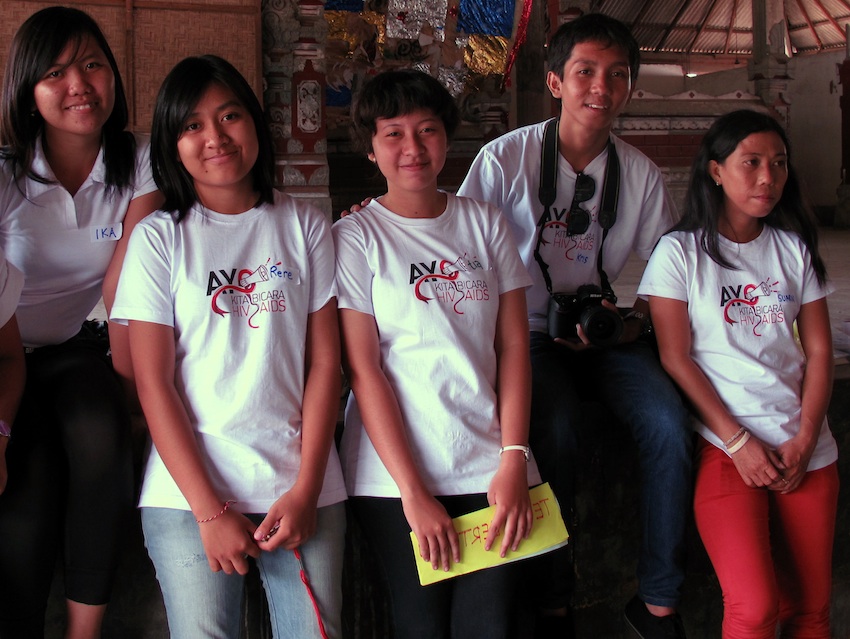
The “EduSpirit” workshops, feature a uniquely Balinese approach that  combines  education, entertainment and spirituality. The aim is to increase awareness and knowledge, but also to develop compassion toward people with AIDS.  Teenagers are promoted as ‘Agents of Change,’ encouraging a ripple on effect through the community, to bring the issue out into the open.  We arrive in Tegellalang where a group of kids from the local school quietly sit waiting. The workshop is run by Wiwie, (Marketing & Communication Executive Officer of Bali Spirit Festival) and a group of young volunteers, mostly from the KISARA foundation. Their enthusiasm is inspiring, and the kids who are initially shy and a little embarrassed soon relax and throw themselves into singing and  teambuilding exercises. Wiwie tells me that they use a gentle approach to break down myths associated with HIV/AIDS. A visual presentation shows that it’s not just sex workers that are susceptible to the disease, but the whole community. Anyone, anywhere, anytime…….. The kids are then divided into small groups to make a presentation that encourages the promotion of empathy and understanding about how the disease affects individuals and their families. The workshop ends with a yoga session. After, I chat with some of the kids, most of them already knew a little about AIDS, but thought that it only affected prostitutes and drug users; they all express that it was good to learn more.

Picture 3 workshops

Desa Seni Yogathon

Currently 25 workshops are planned in various locations around the island, but it is hoped that enough funds can be gathered to conduct 100 workshops over the next year. An  impressive  $14,000 was raised  on March 19 as Bali Spirit partner,  Desa Seni, staged the island’s first Yogathon. The resort took on a festival like atmosphere as more  than 200 people stretched, danced, drummed and  chanted  over 12 hours to raise money and awareness for the cause. In between classes people lazed under palm trees around the pool, enjoying the live music and the complimentary food provided by the resort. This year Desa Seni joined forces with Bali Spirit Festival as a gold sponsor and the yogathon proved an inspiring appetizer for things to come. Tom Talucci, co founder of Desa Seni was thrilled with the success of the event which far exceeded their target of $10,000, and commented,  “When people come together in force its amazing what we can do.


Bali Spirit Festival

Funds for ongoing workshops are also raised through donations, as well as a percentage of ticket sales from the festival itself. Bali Spirit is now well on its way to becoming the most famous holistic event in Asia, attracting world renowned yogis, performers and musicians. The annual event was born out of a vision to build and support community within the context of global music, yoga and dance. But  according to festival founders, “The greatest accomplishment is the ongoing outreach and education programs funded and fueled by the festival,” with over US $34,000 being donated to local charities.

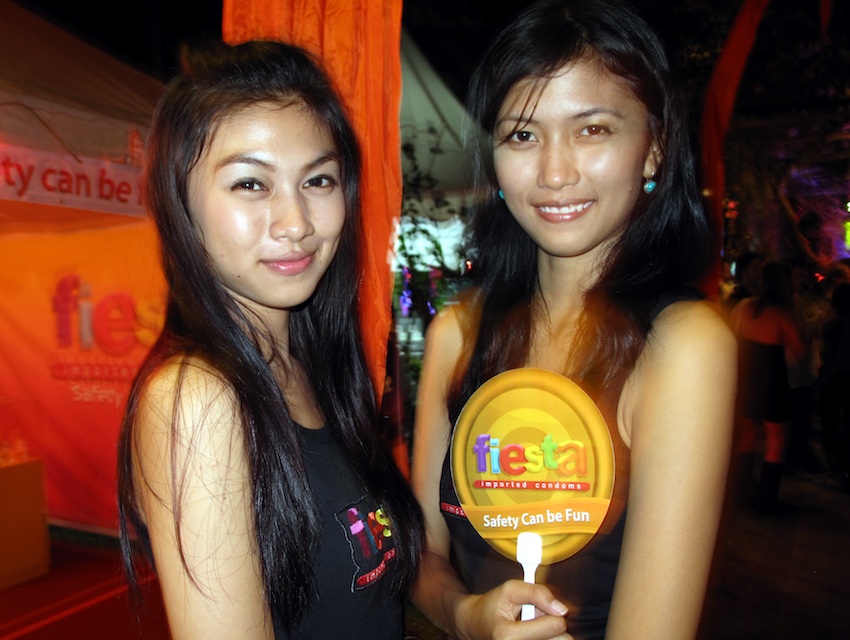
Two years ago I met with festival co founder (and wife of Kadek,) Megan Pappenheim to talk about community outreach. She spoke of her concerns that there were parts of Bali that were being devastated by AIDS, but nobody knew about it because nobody was talking about it. It was  her  intention to  find a condom company to sponsor the festival, and to channel funds into AIDS awareness. True to her word, Fiesta Condoms were signed up as a major sponsor, and have become a highly visible presence at the festival, with an  information pavilion staffed by the lovely  ‘Fiesta girls’ handing out free condoms and Fiesta fans to the crowds.  Ayo! Kita Bicara HIV/AIDS was officially launched in March with a free rock concert in Ubud attended by over 3000 people, the majority of whom were Balinese youth. Information brochures and condoms were handed out, and the crowd was treated to some great music from Indonesian artists KIS, Ray D’Sky  and African legend Afro Moses (who headlined the festival last year.) Festival outreach staff were approached by a number of teenagers to find out how their schools could become involved in the program.  “We’re surprised and delighted at the extraordinarily high turnout for this community event,” said Megan,  “Tonight, Balinese people showed they can have fun and care about a very important cause.”

picture 5 fiesta girls

HIV/AIDS was first recorded in Bali in 2000, among intravenous drug users, with an estimated 40-60% of known addicts testing HIV positive. However, a survey conducted six years later showed that the rate of new infections had been substantially curved through methadone treatment and free needle-exchange-programs. The recent surge in new infections is linked to the Island’s commercial sex workers, and the family members of their clients.  It is estimated that in some parts of Bali up to 20% of sex workers are HIV positive, but despite active education campaigns, only 30% of clients use prophylactics.  When you consider that approximately 8000 commercial sex workers are servicing around 90,000 clients, 60% of whom are married with children, the picture is worrying.

Yayasan Kerti Praja

I chat with Ayu, of Yayasan Kerti Praja, who have a booth at the festival, she tells me that they run the Amarta Clinic in Denpasar, offering  free STD testing, as well as  medical care and psychological support for AIDS patients. The foundation mostly works with women who have been effected by the disease, either by their husbands, or by their profession. Their mobile units visit bars and kafes offering free screening, as well as  conducting focus groups with commercial sex workers, many of who are still not aware of the dangers posed by unprotected sex, (which I learn can be  had for as cheaply as RP 20,000 in roadside brothels.) The part time sex workers – girls who operate independently out of clubs are harder to reach, as they tend deny being ‘professionals’, tending to seek longer term ‘boyfriend’ clients. She tells me that there is still a mistaken, but widely held belief that you  don’t need to use a condom if you love someone;  and that if someone appears ‘clean’ they are safe.

Kerti Praja also run a project entitled  ReLife, the positive craft, which  provides incomes for families effected by HIV/AIDS, due to husbands who have died or are too sick to work, and also former sex workers who are seeking an alternative form of income. Relife products are made from non recyclable plastic waste collected and cleaned by the women which is then turned into a range of bags, purses and wallets.

AIDS is a problem that is not simply going to disappear, but it is preventable, people just need to know how. So talk about it, especially with Indonesian friends who may not have access to this information. Anyone wishing to learn more, or to  donate money, resources or time to Ayo! Kita Bicara HIV/AIDS can contact Wiwie at admin@balispiritfestival.com

Yoga and Meditation

Daniel Aaron interview

It is said that eyes are the windows of the soul, and the first thing I notice about Daniel Aaron are sparkling blue eyes that radiate calmness, compassion and knowingness. As the creator of Radiantly Alive, he aims to uplift our world through unique and powerfully transformative yoga experiences. But if you are picturing a white robed, long haired guru in sandalwood beads speaking in mantras, think again.  Daniel is very much a modern day yogi  (he prefers “human potential guide”) who also happens to make awesome raw chocolate, delves in astrology, runs yoga teacher training programs, and facilitates raw food chef courses. He has been keeping it real in Bali for the past five years and this month launches his Radiantly Alive studio in Ubud.

In a moment of serendipity our meeting coincides with Bali Spirit Festival, a 5-day celebration of yoga, music, dance where lush tropical gardens have been transformed into a hive of holistic activity. Impressive feats of balance are taking place in the acro yoga workshop, while pure crystal sound resonates from the crystal bowl healing workshop. I catch Daniel giving a talk on raw food in one of the pavilions. He is warm and likeable with a tendency to say “Y’all” a lot, in a way that is both embracing and endearing; he also has a natural gift for story telling which has the audience hanging on every word. “I have been playing around with stuff to feel better for a long time,” he tells us, tracing the origins of his transformation back 20 years. “I had a standard American sad diet with meat every meal…. I  was fat, depressed, and that was on a good day…… I started to think, this isn’t right, what can I do differently ?” Vegetarianism came first, but he likens this time to a crack in a windshield, which spread slowly but surely in a myriad of spiritual and health-driven directions as he journeyed across the globe, learning from dozens of teachers, living his life luminously, consciously, with full purpose.

His talk over, we go in search of fresh drinking coconuts, and wind up immersed in lively conversation as we sink into two squishy white bean bags under the shade of a palm tree. Daniel tells me that intuition led him to Bali, “I love the diversity of people, the fecundity of the land, the creativity that it inspires…. and I love coconuts,” he says. I ask if there was a cataclysmic moment that brought yoga into his life. He responds that a few years down the transformation road, a friend invited him to fire walk. Part of the preparation was a yoga class,  “I always thought yoga was for pansies,” he says “so I was surprised to find that I liked it.” He describes  Yoga as Alchemy, “You have to put in enough of a challenge and level of difficulty for it to work.” Daniel has a reputation for inspiring people to go beyond what they thought was possible, and tells me that he is motivated by “Making people feel more alive, more vibrant, encouraging them to discover, how good can it get?” Feeling good is obviously something that we all aspire to which leads logically to our next subject. Chocolate! Not mass produced confectionary high in sugar and milk, but the pure, gooey, healthy, raw kind, which he makes himself. I ask if he has any for me to try, he smiles, digs into his bag and produces a container with some of his latest creations.  I choose a dainty truffle infused with a hint of cardamom. It’s delicious, so good in fact that I could happily eat the whole lot, but that would be rather cheeky, so I manage to restrain myself.

The photographer arrives and we wander about the festival looking for the right backdrop; a west African dance workshop is underway and the tribal rhythms of the djembe create a lively soundtrack. Daniel is super chilled and easy going as we shoot in a number of locations; his  initial shyness with the camera surprises me – or perhaps its not shyness, but rather a refreshing sense of humility. Yet, his playfulness is revealed when he offers to climb into a tree and sit in lotus pose, it doesn’t look so comfortable, but he sees it though. I ask him to describe himself in three words and he comes up with “Inspiring” (yes, he has certainly inspired me,) “Quirky” (well, he is sitting in a tree,) and “Discerning” (obvious in his life choices.) I have just one last question;  what makes you happy? “Deep honesty, intimacy, seeing people transform, my daughter, nature, belly laughs, quality, artistry…..”

A few days later I am doing some background research and discover that Daniel is also a writer. His thoughts,  favourite poems, and inspirational quotes can be found scattered about his blog and websites, which is where I find this little gem that just says it all. “Our life is our project. We can make it an exceptional canvas of dreams and inspirations. Everything that passes through us is a brushstroke: each thought, bite of food, every interaction, how we spend our time, where we live. Life is as vibrant, alive, juicy and beautiful as we choose.”